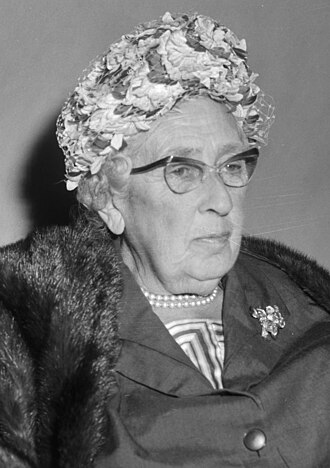

Agatha Christie
1890–1976
Agatha Mary Clarissa Miller was born in Torquay, Devon, in the United Kingdom, the daughter of a wealthy American stockbroker. Her father died when she was eleven years old. Her mother taught her at home, encouraging her to write at a very young age. At the age of 16, she went to Mrs. Dryden's finishing school in Paris to study singing and piano. In 1914, at age 24, she married Colonel Archibald Christie, an aviator in the Royal Flying Corps. While he went away to war, she worked as a nurse and wrote her first novel, The Mysterious Affair at Styles (1920), which wasn't published until four years later. When her husband came back from the war, they had a daughter. In 1928 she divorced her husband, who had been having an affair. In 1930, she married Sir Max Mallowan, an archaeologist and a Catholic. She was happy in the early years of her second marriage, and did not divorce her husband despite his many affairs. She travelled with her husband's job, and set several of her novels set in the Middle East. Most of her other novels were set in a fictionalized Devon, where she was born. Agatha Christie is credited with developing the "cozy style" of mystery, which became popular in, and ultimately defined, the Golden Age of fiction in England in the 1920s and '30s, an age of which she is considered to have been Queen. In all, she wrote over 66 novels, numerous short stories and screenplays, and a series of romantic novels using the pen name Mary Westmacott. She was the single most popular mystery writer of all time. In 1971 she was made a Dame Commander of the Order of the British Empire.
Books by Agatha Christie
12 titles


Quotes from Agatha Christie
“It is a curious thought, but it is only when you see people looking ridiculous that you realize just how much you love them.”
Read quote →
“To every problem, there is a most simple solution.”
Read quote →
“If you place your head in a lion's mouth, then you cannot complain one day if he happens to bite it off.”
Read quote →
“We are the same people as we were at three, six, ten or twenty years old. More noticeably so, perhaps, at six or seven, because we were not pretending so much then.”
Read quote →
“The impossible could not have happened, therefore the impossible must be possible in spite of appearances.”
Read quote →
“Very few of us are what we seem.”
Read quote →