
← Back to QuotesQuotes / Ernest Hemingway
Life & Philosophy20th Century
“I never used to realize it, I guess. I try and play it along and just not make trouble for people. Probably I never would have had any trouble at all if I hadn't run into Brett when they shipped me to England. I suppose she only wanted what she couldn't have. Well, people were that way. To hell with people. The Catholic Church had an awfully good way of handling all that. Good advice, anyway. Not to think about it. Oh, it was swell advice. Try and take it sometime. Try and take it.” — Ernest Hemingway
I never used to realize it, I guess. I try and play it along and just not make trouble for people. Probably I never would have had any trouble at all if I hadn't run into Brett when they shipped me to England. I suppose she only wanted what she couldn't have. Well, people were that way. To hell with people. The Catholic Church had an awfully good way of handling all that. Good advice, anyway. Not to think about it. Oh, it was swell advice. Try and take it sometime. Try and take it.
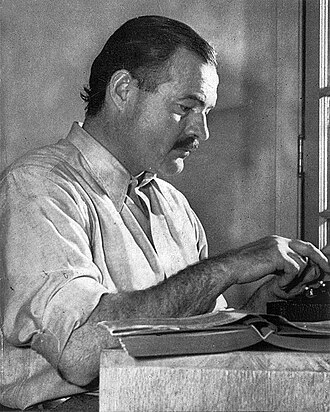
Ernest Hemingway
Novelist & Nobel Laureate — The Sun Also Rises
Typographic edition
No artwork cached for this quote yet. On a reader’s first visit, WSIRN can generate bespoke artwork, cache it, and queue it for editorial review.
About Ernest Hemingway
Novelist & Nobel Laureate (1899–1961)
Ernest Miller Hemingway was an American writer and journalist. During his lifetime he wrote and had published seven novels; six collections of short stories; and two works of non-fiction. Since his death three novels, four collections of short stories, and three non-fiction autobiographical works have been published. Hemingway received the Nobel Prize in Literature in 1954. Hemingway was born and raised in Oak Park, Illinois. After high school he worked as a reporter but within months he left for the Italian front to be an ambulance driver in World War I. He was seriously injured and returned home within the year. He married his first wife Hadley Richardson in 1922 and moved to Paris, where he worked as a foreign correspondent. During this time Hemingway met, and was influenced by, writers and artists of the 1920s expatriate community known as the "Lost Generation". In 1924 Hemingway wrote his first novel, The Sun Also Rises. In the late 1920s, Hemingway divorced Hadley, married his second wife Pauline Pfeiffer, and moved to Key West, Florida. In 1937 Hemingway went to Spain as a war correspondent to cover the Spanish Civil War. After the war he divorced Pauline, married his third wife Martha Gellhorn, wrote For Whom the Bell Tolls, and moved to Cuba. Hemingway covered World War II in Europe and he was present at Operation Overlord. Later he was in Paris during the liberation of Paris. After the war, he divorced again, married his fourth wife Mary Welsh Hemingway, and wrote Across the River and Into the Trees. Two years later, The Old Man and the Sea was published in 1952. Nine years later, after moving from Cuba to Idaho, he committed suicide in the summer of 1961. Hemingway produced most of his work between the mid 1920s and the mid 1950s, though a number of unfinished works were published posthumously. Hemingway's distinctive writing style is characterized by economy and understatement, and had a significant influence on the development of twentieth-century fiction writing. His protagonists are typically stoical men who exhibit an ideal described as "grace under pressure." Many of his works are now considered classics of American literature. During his lifetime, Hemingway's popularity peaked after the publication of The Old Man and the Sea. Source and more information:
Share Card Studio
Books Like The Sun Also Rises


Kindred Quotes

“You've gotta dance like there's nobody watching, Love like you'll never be hurt, Sing like there's nobody listening, And live like it's heaven on earth.”
William W. Purkey
Writer & Voice
“I'm not afraid of death; I just don't want to be there when it happens.”
Woody Allen
Writer & Voice
“A day without sunshine is like, you know, night.”
Steve Martin
Writer & Voice