← Back to QuotesQuotes / Ernest Hemingway
“You felt, in spite of all bureaucracy and inefficiency and party strife something that was like the feeling you expected to have and did not have when you made your first communion. It was a feeling of consecration to a duty toward all of the oppressed of the world which would be as difficult and embarrasing to speak about as religious experience and yet it was as authentic as the feeling you had when you heard Bach, or stood in Chartres Cathedral or the Cathedral at León and saw the light coming through the great windows; or when you saw Mantegna and Greco and Brueghel in the Prado. It gave you a part in something that you could believe in wholly and completely and in which you felt an absolute brotherhood with the others who were engaged in it. It was something that you had never known before but that you had experienced now and you gave such importance to it and the reasons for it that you own death seemed of complete unimportance; only a thing to be avoided because it would interfere with the performance of your duty. But the best thing was that there was something you could do about this feeling and this necessity too. You could fight.” — Ernest Hemingway
You felt, in spite of all bureaucracy and inefficiency and party strife something that was like the feeling you expected to have and did not have when you made your first communion. It was a feeling of consecration to a duty toward all of the oppressed of the world which would be as difficult and embarrasing to speak about as religious experience and yet it was as authentic as the feeling you had when you heard Bach, or stood in Chartres Cathedral or the Cathedral at León and saw the light coming through the great windows; or when you saw Mantegna and Greco and Brueghel in the Prado. It gave you a part in something that you could believe in wholly and completely and in which you felt an absolute brotherhood with the others who were engaged in it. It was something that you had never known before but that you had experienced now and you gave such importance to it and the reasons for it that you own death seemed of complete unimportance; only a thing to be avoided because it would interfere with the performance of your duty. But the best thing was that there was something you could do about this feeling and this necessity too. You could fight.
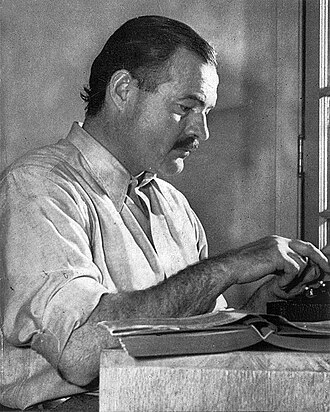
Ernest Hemingway
Novelist & Nobel Laureate — For Whom the Bell Tolls
Typographic edition
No artwork cached for this quote yet. On a reader’s first visit, WSIRN can generate bespoke artwork, cache it, and queue it for editorial review.
About Ernest Hemingway
Novelist & Nobel Laureate (1899–1961)
Ernest Miller Hemingway was an American writer and journalist. During his lifetime he wrote and had published seven novels; six collections of short stories; and two works of non-fiction. Since his death three novels, four collections of short stories, and three non-fiction autobiographical works have been published. Hemingway received the Nobel Prize in Literature in 1954. Hemingway was born and raised in Oak Park, Illinois. After high school he worked as a reporter but within months he left for the Italian front to be an ambulance driver in World War I. He was seriously injured and returned home within the year. He married his first wife Hadley Richardson in 1922 and moved to Paris, where he worked as a foreign correspondent. During this time Hemingway met, and was influenced by, writers and artists of the 1920s expatriate community known as the "Lost Generation". In 1924 Hemingway wrote his first novel, The Sun Also Rises. In the late 1920s, Hemingway divorced Hadley, married his second wife Pauline Pfeiffer, and moved to Key West, Florida. In 1937 Hemingway went to Spain as a war correspondent to cover the Spanish Civil War. After the war he divorced Pauline, married his third wife Martha Gellhorn, wrote For Whom the Bell Tolls, and moved to Cuba. Hemingway covered World War II in Europe and he was present at Operation Overlord. Later he was in Paris during the liberation of Paris. After the war, he divorced again, married his fourth wife Mary Welsh Hemingway, and wrote Across the River and Into the Trees. Two years later, The Old Man and the Sea was published in 1952. Nine years later, after moving from Cuba to Idaho, he committed suicide in the summer of 1961. Hemingway produced most of his work between the mid 1920s and the mid 1950s, though a number of unfinished works were published posthumously. Hemingway's distinctive writing style is characterized by economy and understatement, and had a significant influence on the development of twentieth-century fiction writing. His protagonists are typically stoical men who exhibit an ideal described as "grace under pressure." Many of his works are now considered classics of American literature. During his lifetime, Hemingway's popularity peaked after the publication of The Old Man and the Sea. Source and more information:
Share Card Studio
Books Like For Whom the Bell Tolls


Kindred Quotes
“All that is gold does not glitter, Not all those who wander are lost; The old that is strong does not wither, Deep roots are not reached by the frost. From the ashes a fire shall be woken, A light from the shadows shall spring; Renewed shall be blade that was broken, The crownless again shall be king.”
J.R.R. Tolkien
Author & Philologist
“I must not fear. Fear is the mind-killer. Fear is the little-death that brings total obliteration. I will face my fear. I will permit it to pass over me and through me. And when it has gone past I will turn the inner eye to see its path. Where the fear has gone there will be nothing. Only I will remain.”
Frank Herbert
Science Fiction Author

“You've gotta dance like there's nobody watching, Love like you'll never be hurt, Sing like there's nobody listening, And live like it's heaven on earth.”
William W. Purkey
Writer & Voice