← Back to QuotesQuotes / Friedrich Nietzsche

“Language as putative science. - The significance of language for the evolution of culture lies in this, that mankind set up in language a separate world beside the other world, a place it took to be so firmly set that, standing upon it, it could lift the rest of the world off its hinges and make itself master of it. To the extent that man has for long ages believed in the concepts and names of things as in aeternae veritates he has appropriated to himself that pride by which he raised himself above the animal: he really thought that in language he possessed knowledge of the world. The sculptor of language was not so modest as to believe that he was only giving things designations, he conceived rather that with words he was expressing supreame knowledge of things; language is, in fact, the first stage of occupation with science. Here, too, it is the belief that the truth has been found out of which the mightiest sources of energy have flowed. A great deal later - only now - it dawns on men that in their belief in language they have propagated a tremendous error. Happily, it is too late for the evolution of reason, which depends on this belief, to be put back. - Logic too depends on presuppositions with which nothing in the real world corresponds, for example on the presupposition that there are identical things, that the same thing is identical at different points of time: but this science came into existence through the opposite belief (that such conditions do obtain in the real world). It is the same with mathematics, which would certainly not have come into existence if one had known from the beginning that there was in nature no exactly straight line, no real circle, no absolute magnitude.” — Friedrich Nietzsche
“Language as putative science. - The significance of language for the evolution of culture lies in this, that mankind set up in language a separate world beside the other world, a place it took to be so firmly set that, standing upon it, it could lift the rest of the world off its hinges and make itself master of it. To the extent that man has for long ages believed in the concepts and names of things as in aeternae veritates he has appropriated to himself that pride by which he raised himself above the animal: he really thought that in language he possessed knowledge of the world. The sculptor of language was not so modest as to believe that he was only giving things designations, he conceived rather that with words he was expressing supreame knowledge of things; language is, in fact, the first stage of occupation with science. Here, too, it is the belief that the truth has been found out of which the mightiest sources of energy have flowed. A great deal later - only now - it dawns on men that in their belief in language they have propagated a tremendous error. Happily, it is too late for the evolution of reason, which depends on this belief, to be put back. - Logic too depends on presuppositions with which nothing in the real world corresponds, for example on the presupposition that there are identical things, that the same thing is identical at different points of time: but this science came into existence through the opposite belief (that such conditions do obtain in the real world). It is the same with mathematics, which would certainly not have come into existence if one had known from the beginning that there was in nature no exactly straight line, no real circle, no absolute magnitude.”
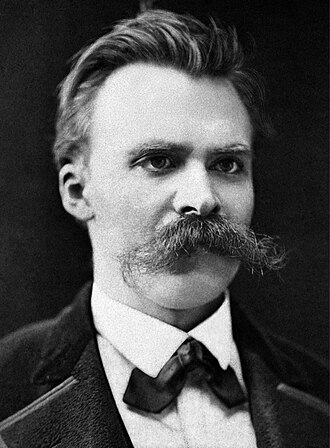
Friedrich Nietzsche
Philosopher — Human
About Friedrich Nietzsche
Philosopher (1844–1900)
Friedrich Nietzsche was a 19th-century German philosopher and classical philologist whose sharp critiques of morality, religion, and modern culture reshaped European thought. Trained in philology before turning fully to philosophy, he wrote provocative books such as Thus Spoke Zarathustra, Beyond Good and Evil, and On the Genealogy of Morality, which introduced ideas like the will to power and the revaluation of all values. His work later became foundational for existentialism and postmodern thinking.
Share Card Studio
Books by Friedrich Nietzsche


Kindred Quotes
“The man of knowledge must be able not only to love his enemies but also to hate his friends.”
Friedrich Nietzsche
Philosopher
“The saddest aspect of life right now is that science gathers knowledge faster than society gathers wisdom.”
Isaac Asimov
Writer & Voice

“A human being is a part of the whole called by us universe, a part limited in time and space. He experiences himself, his thoughts and feeling as something separated from the rest, a kind of optical delusion of his consciousness. This delusion is a kind of prison for us, restricting us to our personal desires and to affection for a few persons nearest to us. Our task must be to free ourselves from this prison by widening our circle of compassion to embrace all living creatures and the whole of nature in its beauty.”
Albert Einstein
Theoretical Physicist