← Back to QuotesQuotes / Fyodor Dostoevsky
Love & Human Connection, Science & the Cosmos, Life & Philosophy19th Century#curiosity#truth#justice
“No, it is not a commonplace, sir! If up to now, for example, I have been told to 'love my neighbor,' and I did love him, what came of it?. . . What came of it was that I tore my caftan in two, shared it with my neighbor, and we were both left half naked, in accordance with the Russian proverb which says: If you chase several hares at once, you won't overtake any one of them. But science says: Love yourself before all, because everything in the world is based on self-interest. If you love only yourself, you will set your affairs up properly, and your caftan will also remain in one piece. And economic truth adds that the more properly arranged personal affairs and, so to speak, whole caftans there are in society, the firmer its foundations are and the better arranged its common cause. It follows that by acquiring for everyone, as it were, and working so that my neighbor will have something more than a torn caftan, not from private, isolated generosities now, but as a result of universal prosperity.” — Fyodor Dostoevsky
“No, it is not a commonplace, sir! If up to now, for example, I have been told to 'love my neighbor,' and I did love him, what came of it?. . . What came of it was that I tore my caftan in two, shared it with my neighbor, and we were both left half naked, in accordance with the Russian proverb which says: If you chase several hares at once, you won't overtake any one of them. But science says: Love yourself before all, because everything in the world is based on self-interest. If you love only yourself, you will set your affairs up properly, and your caftan will also remain in one piece. And economic truth adds that the more properly arranged personal affairs and, so to speak, whole caftans there are in society, the firmer its foundations are and the better arranged its common cause. It follows that by acquiring for everyone, as it were, and working so that my neighbor will have something more than a torn caftan, not from private, isolated generosities now, but as a result of universal prosperity.”
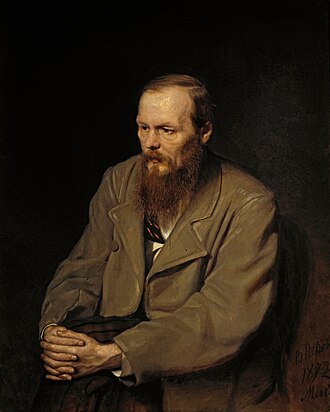
Fyodor Dostoevsky
Russian Novelist — Crime and Punishment
About Fyodor Dostoevsky
Russian Novelist (1821–1881)
Russian novelist and philosopher whose psychological masterpieces include Crime and Punishment and The Brothers Karamazov.
Share Card Studio
Books Like Crime and Punishment


Kindred Quotes

“Doubt thou the stars are fire; Doubt that the sun doth move; Doubt truth to be a liar; But never doubt I love.”
William Shakespeare
Playwright & Poet

“A lady's imagination is very rapid; it jumps from admiration to love, from love to matrimony in a moment.”
Jane Austen
English Novelist
“You've gotta dance like there's nobody watching, Love like you'll never be hurt, Sing like there's nobody listening, And live like it's heaven on earth.”
William W. Purkey
Writer & Voice