← Back to QuotesQuotes / Pablo Neruda
“Don't go far off, not even for a day, because I don't know how to say it - a day is long and I will be waiting for you, as in an empty station when the trains are parked off somewhere else, asleep. Don't leave me, even for an hour, because then the little drops of anguish will all run together, the smoke that roams looking for a home will drift into me, choking my lost heart. Oh, may your silhouette never dissolve on the beach, may your eyelids never flutter into the empty distance. Don't LEAVE me for a second, my dearest, because in that moment you'll have gone so far I'll wander mazily over all the earth, asking, will you come back? Will you leave me here, dying?” — Pablo Neruda
“Don't go far off, not even for a day, because I don't know how to say it - a day is long and I will be waiting for you, as in an empty station when the trains are parked off somewhere else, asleep. Don't leave me, even for an hour, because then the little drops of anguish will all run together, the smoke that roams looking for a home will drift into me, choking my lost heart. Oh, may your silhouette never dissolve on the beach, may your eyelids never flutter into the empty distance. Don't LEAVE me for a second, my dearest, because in that moment you'll have gone so far I'll wander mazily over all the earth, asking, will you come back? Will you leave me here, dying?”
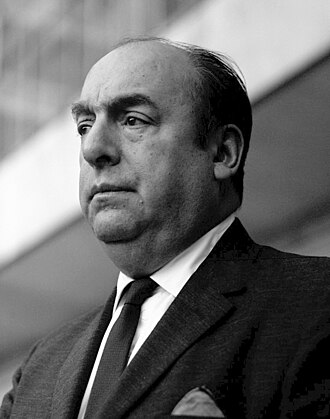
Pablo Neruda
Chilean Poet
About Pablo Neruda
Chilean Poet (1904–1973)
Chilean poet, diplomat, and politician Pablo Neruda, born Neftalí Ricardo Reyes Basoalto, moved from intimate love lyrics to surrealist experiment and openly political verse over a career that spanned much of the twentieth century. His breakthrough collection, Twenty Love Poems and a Song of Despair, published in 1924, remains a touchstone for its raw eroticism and melancholy, while his later work took up socialist causes and the historical sweep of Latin America. Awarded the Nobel Prize in Literature in 1971, he also served as a senator and as a diplomat in Spain, Mexico, and France. His prose memoir, Confieso que he vivido, is read alongside his poems, though his legacy remains complicated by his political loyalties and by a confession of sexual violence recounted in its pages.
Share Card Studio
Books by Pablo Neruda


Kindred Quotes

“A lady's imagination is very rapid; it jumps from admiration to love, from love to matrimony in a moment.”
Jane Austen
English Novelist
“You've gotta dance like there's nobody watching, Love like you'll never be hurt, Sing like there's nobody listening, And live like it's heaven on earth.”
William W. Purkey
Writer & Voice
“I love you without knowing how, or when, or from where. I love you simply, without problems or pride: I love you in this way because I do not know any other way of loving but this, in which there is no I or you, so intimate that your hand upon my chest is my hand, so intimate that when I fall asleep your eyes close.”
Pablo Neruda
Chilean Poet