← Back to QuotesQuotes / Ursula K. Le Guin
“I’ve read all my life, and I read everything. I’ve been so influenced by so much that as soon as I mention one name I think, “Oh, but I cant’s say that without saying that.” I think there are certain obvious big guns, but I really hate to say any one, or six, or twenty. But you could very roughly say that the English novelists of the nineteenth century and the Russian novelists of the nineteenth century were formative. That’s where my love and admiration end emulation was when I started. But then I read all that other junk, too. And I did my college work in French and Italian literature. I never much liked the French novelists. I can tell you what I don’t like. I don’t much like “the great tradition,” the James-Conrad thing that I was supposed to like when I was in college. I’ve revolted against that fairly consciously. Flaubert I really consider a very bad model for fiction writer.” — Ursula K. Le Guin
“I’ve read all my life, and I read everything. I’ve been so influenced by so much that as soon as I mention one name I think, “Oh, but I cant’s say that without saying that.” I think there are certain obvious big guns, but I really hate to say any one, or six, or twenty. But you could very roughly say that the English novelists of the nineteenth century and the Russian novelists of the nineteenth century were formative. That’s where my love and admiration end emulation was when I started. But then I read all that other junk, too. And I did my college work in French and Italian literature. I never much liked the French novelists. I can tell you what I don’t like. I don’t much like “the great tradition,” the James-Conrad thing that I was supposed to like when I was in college. I’ve revolted against that fairly consciously. Flaubert I really consider a very bad model for fiction writer.”
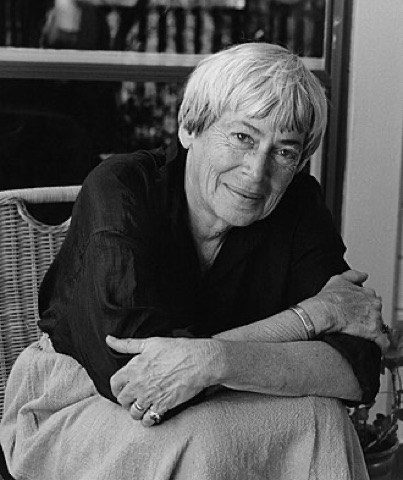
Ursula K. Le Guin
Speculative Novelist
About Ursula K. Le Guin
Speculative Novelist (1929–2018)
Ursula K. Le Guin, born in Berkeley, California in 1929, became one of the most influential American voices in speculative fiction across a career that stretched nearly six decades. Raised among anthropologists and the stories of California's indigenous peoples, she brought a cultural curiosity and quiet moral seriousness to her imagined worlds, probing gender, power, and ecological balance. Her Earthsea fantasies, beginning with A Wizard of Earthsea, remain beloved classics, while The Left Hand of Darkness and The Dispossessed, both set in her Hainish universe, examine utopian ideals and anarchist principles with rare intellectual depth. Her celebrated work earned five Hugo Awards and six Nebula Awards, and she lived out her later years in Portland, Oregon.
Share Card Studio
Books by Ursula K. Le Guin

Kindred Quotes
“As he read, I fell in love the way you fall asleep: slowly, and then all at once.”
John Green
American Author
“What really knocks me out is a book that, when you're all done reading it, you wish the author that wrote it was a terrific friend of yours and you could call him up on the phone whenever you felt like it. That doesn't happen much, though.”
J.D. Salinger
Author

“We accept the love we think we deserve.”
Stephen Chbosky
Author