← Back to QuotesQuotes / Ursula K. Le Guin

“If a book were written all in numbers, it would be true. It would be just. Nothing said in words ever came out quite even. Things in words got twisted and ran together, instead of staying straight and fitting together. But underneath the words, at the center, like the center of the Square, it all came out even. Everything could change, yet nothing would be lost. If you saw the numbers you could see that, the balance, the pattern. You saw the foundations of the world. And they were solid.” — Ursula K. Le Guin
“If a book were written all in numbers, it would be true. It would be just. Nothing said in words ever came out quite even. Things in words got twisted and ran together, instead of staying straight and fitting together. But underneath the words, at the center, like the center of the Square, it all came out even. Everything could change, yet nothing would be lost. If you saw the numbers you could see that, the balance, the pattern. You saw the foundations of the world. And they were solid.”
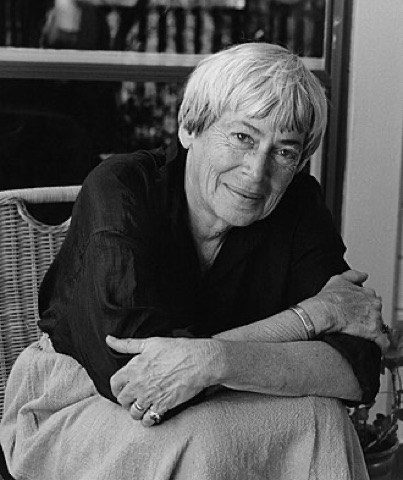
Ursula K. Le Guin
Speculative Novelist — The Dispossessed
About Ursula K. Le Guin
Speculative Novelist (1929–2018)
Ursula K. Le Guin, born in Berkeley, California in 1929, became one of the most influential American voices in speculative fiction across a career that stretched nearly six decades. Raised among anthropologists and the stories of California's indigenous peoples, she brought a cultural curiosity and quiet moral seriousness to her imagined worlds, probing gender, power, and ecological balance. Her Earthsea fantasies, beginning with A Wizard of Earthsea, remain beloved classics, while The Left Hand of Darkness and The Dispossessed, both set in her Hainish universe, examine utopian ideals and anarchist principles with rare intellectual depth. Her celebrated work earned five Hugo Awards and six Nebula Awards, and she lived out her later years in Portland, Oregon.
Share Card Studio
Books by Ursula K. Le Guin

Kindred Quotes
“As he read, I fell in love the way you fall asleep: slowly, and then all at once.”
John Green
American Author

“If you only read the books that everyone else is reading, you can only think what everyone else is thinking.”
Haruki Murakami
Japanese Novelist

“The person, be it gentleman or lady, who has not pleasure in a good novel, must be intolerably stupid.”
Jane Austen
English Novelist