← Back to QuotesQuotes / Virginia Woolf
“However, the majority of women are neither harlots nor courtesans; nor do they sit clasping pug dogs to dusty velvet all through the summer afternoon. But what do they do then? and there came to my mind’s eye one of those long streets somewhere south of the river whose infinite rows are innumerably populated. With the eye of the imagination I saw a very ancient lady crossing the street on the arm of a middle-aged woman, her daughter, perhaps, both so respectably booted and furred that their dressing in the afternoon must be a ritual, and the clothes themselves put away in cupboards with camphor, year after year, throughout the summer months. They cross the road when the lamps are being lit (for the dusk is their favourite hour), as they must have done year after year. The elder is close on eighty; but if one asked her what her life has meant to her, she would say that she remembered the streets lit for the battle of Balaclava, or had heard the guns fire in Hyde Park for the birth of King Edward the Seventh. And if one asked her, longing to pin down the moment with date and season, but what were you doing on the fifth of April 1868, or the second of November 1875, she would look vague and say that she could remember nothing. For all the dinners are cooked; the plates and cups washed; the children sent to school and gone out into the world. Nothing remains of it all. All has vanished. No biography or history has a word to say about it. And the novels, without meaning to, inevitably lie. All these infinitely obscure lives remain to be recorded, I said, addressing Mary Carmichael as if she were present; and went on in thought through the streets of London feeling in imagination the pressure of dumbness, the accumulation of unrecorded life, whether from the women at the street corners with their arms akimbo, and the rings embedded in their fat swollen fingers, talking with a gesticulation like the swing of Shakespeare’s words; or from the violet-sellers and match-sellers and old crones stationed under doorways; or from drifting girls whose faces, like waves in sun and cloud, signal the coming of men and women and the flickering lights of shop windows. All that you will have to explore, I said to Mary Carmichael, holding your torch firm in your hand.” — Virginia Woolf
However, the majority of women are neither harlots nor courtesans; nor do they sit clasping pug dogs to dusty velvet all through the summer afternoon. But what do they do then? and there came to my mind’s eye one of those long streets somewhere south of the river whose infinite rows are innumerably populated. With the eye of the imagination I saw a very ancient lady crossing the street on the arm of a middle-aged woman, her daughter, perhaps, both so respectably booted and furred that their dressing in the afternoon must be a ritual, and the clothes themselves put away in cupboards with camphor, year after year, throughout the summer months. They cross the road when the lamps are being lit (for the dusk is their favourite hour), as they must have done year after year. The elder is close on eighty; but if one asked her what her life has meant to her, she would say that she remembered the streets lit for the battle of Balaclava, or had heard the guns fire in Hyde Park for the birth of King Edward the Seventh. And if one asked her, longing to pin down the moment with date and season, but what were you doing on the fifth of April 1868, or the second of November 1875, she would look vague and say that she could remember nothing. For all the dinners are cooked; the plates and cups washed; the children sent to school and gone out into the world. Nothing remains of it all. All has vanished. No biography or history has a word to say about it. And the novels, without meaning to, inevitably lie. All these infinitely obscure lives remain to be recorded, I said, addressing Mary Carmichael as if she were present; and went on in thought through the streets of London feeling in imagination the pressure of dumbness, the accumulation of unrecorded life, whether from the women at the street corners with their arms akimbo, and the rings embedded in their fat swollen fingers, talking with a gesticulation like the swing of Shakespeare’s words; or from the violet-sellers and match-sellers and old crones stationed under doorways; or from drifting girls whose faces, like waves in sun and cloud, signal the coming of men and women and the flickering lights of shop windows. All that you will have to explore, I said to Mary Carmichael, holding your torch firm in your hand.
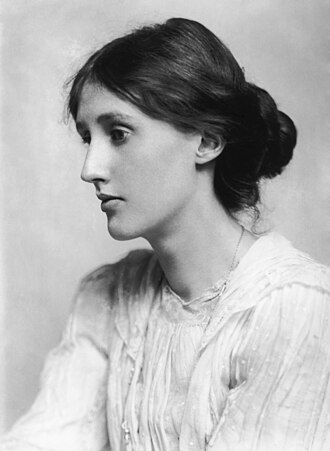
Virginia Woolf
Modernist Novelist — A Room of One's Own
Typographic edition
No artwork cached for this quote yet. On a reader’s first visit, WSIRN can generate bespoke artwork, cache it, and queue it for editorial review.
About Virginia Woolf
Modernist Novelist (1882–1941)
Virginia Woolf was an English novelist, essayist, diarist, epistler, publisher, feminist, and writer of short stories, regarded as one of the foremost modernist literary figures of the twentieth century. Comment from Ursula Le Guin on The Guardian: > You can't write science fiction well if you haven't read it, though not all who try to write it know this. But nor can you write it well if you haven't read anything else. Genre is a rich dialect, in which you can say certain things in a particularly satisfying way, but if it gives up connection with the general literary language it becomes a jargon, meaningful only to an ingroup. Useful models may be found quite outside the genre. I learned a lot from reading the ever-subversive Virginia Woolf. > I was 17 when I read Orlando. It was half-revelation, half-confusion to me at that age, but one thing was clear: that she imagined a society vastly different from our own, an exotic world, and brought it dramatically alive. I'm thinking of the Elizabethan scenes, the winter when the Thames froze over. Reading, I was there, saw the bonfires blazing in the ice, felt the marvellous strangeness of that moment 500 years ago – the authentic thrill of being taken absolutely elsewhere. > How did she do it? By precise, specific descriptive details, not heaped up and not explained: a vivid, telling imagery, highly selected, encouraging the reader's imagination to fill out the picture and see it luminous, complete. > In Flush, Woolf gets inside a dog's mind, that is, a non-human brain, an alien mentality – very science-fictional if you look at it that way. Again what I learned was the power of accurate, vivid, highly selected detail. I imagine Woolf looking down at the dog asleep beside the ratty armchair she wrote in and thinking what are your dreams? and listening... sniffing the wind... after the rabbit, out on the hills, in the dog's timeless world. > Useful stuff, for those who like to see through eyes other than our own.
Share Card Studio
Books Like A Room of One's Own


Kindred Quotes

“A lady's imagination is very rapid; it jumps from admiration to love, from love to matrimony in a moment.”
Jane Austen
English Novelist
“Doubt thou the stars are fire; Doubt that the sun doth move; Doubt truth to be a liar; But never doubt I love.”
William Shakespeare
Playwright & Poet
“The saddest aspect of life right now is that science gathers knowledge faster than society gathers wisdom.”
Isaac Asimov
Writer & Voice